
HOA political signs give homeowners an opportunity to show their support for their chosen candidates. Yet, in an HOA, there’s a little more that goes into the display. Associations are known for enforcing restrictions on what owners can do with their homes, including displaying signs. Understanding these restrictions can help owners avoid violations.
The Prevalence of HOA Political Signs
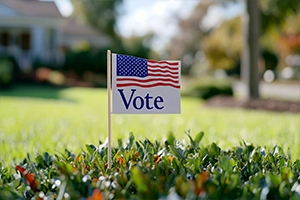
Political signs tend to appear in waves, becoming more frequent and widespread during the election season. In HOA neighborhoods, it is common to see them in yards, windows, and near mailboxes. In condos and townhomes, owners may put them up on balconies, windows, or limited common elements.
The relationship between HOAs and political signs is not straightforward. Homeowners associations are known for enforcing strict decoration and architectural rules, and political signs may fall under them. The goal is to maintain curb appeal, community character, and property values. By allowing free rein on political sign displays, an HOA may not be able to achieve this goal.
There’s also the issue of neighbor disputes. As political alignments can cause disagreements, uncontrolled displays can spark verbal fights or even physical violence. Displays outside the election season can also quickly become eyesores, leading to complaints. For these reasons, many associations address political signs directly in their governing documents.
Can HOA Ban Political Signs?
Whether boards can prohibit political signs in HOA communities depends on two factors: state laws and the governing documents. A handful of states have enacted laws that directly address the issue, protecting the right of homeowners to show their support and to participate in civic life.
Here are some examples:
- Arizona. As per A.R.S. Section 33-1808, associations can’t ban the display of political signs on private lots. That said, they can reasonably restrict the time, place, and manner of the display.
- California. Known for strict HOA laws, California also extends these to political signs. Civil Code Section 4710 prevents HOAs from banning noncommercial signs, including political signs, but they may restrict the size.
- Washington. According to RCW 64.38.034, HOAs can’t prohibit outdoor displays of political yard signs on private property, but the law allows size and placement restrictions.
If the board removes properly placed political signs, it may risk exposure to legal liability. Homeowners can challenge the removal and even file a lawsuit against the association.
Apart from state laws, the CC&Rs and bylaws of an association may also regulate political signs. Many states defer to these documents for the association’s authority to prohibit or restrict such signs.
HOA Political Signs in Common Areas
Homeowners may have the right to display political signs on private property, but this right typically does not extend to common areas. In general, associations may prohibit owners from putting up HOA political signs on HOA-owned property.
Board members may be tempted to display political signs or banners in common spaces, but most experts agree that this is a bad move. Instead, they recommend that associations remain neutral on political matters to avoid conflict and legal problems.
Common HOA Restrictions on Political Signs

Political sign rules aim to maintain a consistent community appearance while allowing owners to express their views. Most associations don’t impose outright bans. Instead, boards typically adopt reasonable restrictions.
Here are the most common HOA rules on political signs.
1. Size of Political Signs
Many associations limit the dimensions of political signs. For example, an HOA may restrict signs to a certain square footage, such as no larger than four or six square feet.
The goal is to prevent oversized banners or commercial-style displays that take up too much space in a front yard or balcony. Such displays are often seen as harsh and can disrupt the neighborhood’s overall aesthetic.
2. Number of Political Signs
Boards usually restrict the number of signs that may be displayed on each private lot. An association might permit one sign per candidate or ballot issue. Another strategy is to cap the total number per lot or unit.
Such a rule can help prevent lots from looking too cluttered. It also reduces the risk of visual disputes between neighbors. Apart from that, limiting the quantity of signs also helps the board enforce the rules more consistently.
3. Placement of Political Signs
Many associations enact rules concerning the placement of HOA political signs. These rules specify where homeowners may install these signs or banners.
In single-family communities, signs are often limited to the owner’s private lot. This means they can’t put up displays in common areas. In condominiums, signs may be allowed inside windows, but the board might prohibit them in hallways or other shared spaces.
4. Timing of Display
Many HOAs regulate when political signs may go up and when they must come down. Associations often allow owners to display the signs a set number of days before an election. They also require removal shortly after voting ends. Enforcing a timeframe prevents signs from staying up indefinitely, which can mess with the aesthetics and character of the community.
Understanding Content-Neutral Rules
While HOAs can reasonably restrict the size, number, placement, and timing of political signs, it is never a good idea to control the content of the signs. Sure, the use of vulgar or offensive language may be prohibited, but boards should not allow signs that support one candidate and not the other.
It is important to adopt content-neutral standards when regulating HOA political signs. Favoring one candidate or political party over another can create tension. It can also expose the association to claims of bias, selective enforcement, or discrimination. If an HOA allows political signs, it must apply the same rules across all residents.
A Balancing Act
The decision to allow HOA political signs largely hinges on state laws and the governing documents. Even if these are silent, boards would be wise to permit such displays, but with content-neutral limitations. When in doubt, board members should seek counsel from an attorney or an HOA management company.
HOA Explore makes it easy for associations to find HOA management companies. Use our online directory today!
RELATED ARTICLES:
- How To Amend HOA Bylaws? A Step-by-Step Guide
- Homeowner As HOA Manager: Pros, Cons, And Legal Risks
- How To Develop HOA Board People Skills That Homeowners Appreciate